
Saturday, December 06, 2008
FLUSHED WITH PRIDE
The art of the toilet in Japan
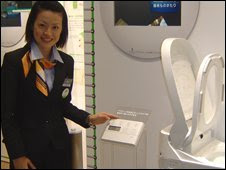 Smart young women at Panasonic show off the latest wares
Duncan Bartlett
(BBC)
No country takes toilets quite so seriously as Japan.
Machines with heated seats, built-in bidets and a dynamic range of flushing options are almost ubiquitous in homes and public buildings.
A poem recently published by a stressed-out salary man captured their comforting appeal with haiku-like brevity. "The only warmth in my life is the toilet seat," he mourned.
But lavatories here can do much more than keep you warm. One even sends a tiny electrical charge through the user's buttocks to check their body-fat ratio.
The master of the modern convenience is the Panasonic Corporation.
Booming market
At its Tokyo showroom, located in a skyscraper near the BBC's office, a group of smart young women, dressed in uniforms resembling flight attendants, showed me the company's latest wares.
The lids lifted up when I approached. If I stood in front of one, it took a guess at my gender and lifted up the seat as well.
There was a loo that glowed in the dark and another that had built-in loudspeakers.
With manicured fingernails, the demonstrator pushed the control panel beside the seat and gentle light classical music began to play.
Pleasant enough, I thought, although I preferred a pastoral sound effect that provided the impression one was seated upon a white plastic throne surrounded by songbirds in a springtime meadow.
 Japanese people do not see cleaning as a demeaning or shameful job
Kyoko Ishii, who heads up the public relations department for Panasonic, explained to me that most of the people who choose luxury loos are older women, so this is a booming market in rapidly ageing Japan.
Kyoko says that for this core customer group, the emphasis now is less on the gadgetry and more on convenience and cleanliness.
A new flush has been invented which does away with the need for a tank and saves dramatically on water.
The device costs about £1,950 ($3,000) including installation. But it is not easy to sell outside Japan as bathrooms in other countries are rarely fitted with the right mixture of sophisticated plumbing and electronics.
Clean culture
A visitor to Tokyo recently told me that he was surprised to find Japanese women rather than foreigners cleaning the toilets in his hotel.
 Advertisements for toilets are screened on public transport
It is of course often immigrants who take on such jobs in rich countries. But foreign-born workers are rare here as only about 1.5% of the population are made up of non-native Japanese.
However, the low immigration level is only part of the explanation. Japanese people do not see cleaning as a demeaning or shameful job.
School children are trained from a young age to sweep their classrooms and scour the playground for litter.
Lorry drivers wash their trucks at the end of every day. No restaurant ever serves a meal without first offering the customer a cleansing towel.
Recently, I visited a small technology company in Osaka. The president, Mr Sugimoto, is trying to inspire his staff to work harder as recession takes hold.
The Japanese - like the British - do not seem to mind too much when comedians sink into vulgarity and joke about scatological matters
He is noted for his drive and enthusiasm and that came across in a punchy presentation which he showed me on his laptop.
It included photographs of his staff on their knees scrubbing the urinals.
His point was that in preparation for a new project, the whole team had mucked in to clean up the workplace and this was clearly a source of pride to be included in the company's publicity.
Source of comfort
But toilets can raise a smile, too. Television comedies sometimes include scenes of pranksters luring people into loos whose walls then collapse, and the embarrassment this causes the victim is a source of great hilarity.
The toilet then appeared to give a welcoming robotic smile and its seat began to glow an inviting orange colour as it heated up, ready for action
The Japanese - like the British - do not seem to mind too much when comedians sink into vulgarity and joke about scatological matters.
But there is also a dark underground trade in DVDs filmed in ladies' toilets by hidden cameras, and only last week a man was arrested for placing "spycams" in the lavatories of a girls' school.
Most of the time, though, the Japanese are happy to think of a toilet as their comfort and their friend.
The other day, while catching a commuter train to work, I found myself transfixed by an advertisement which was being screened on a TV inside the carriage.
A young girl slowly walked towards a loo, which automatically raised its lid to greet her.
The toilet then appeared to give a welcoming robotic smile and its seat began to glow an inviting orange colour as it heated up, ready for action.
Fortunately, the advertisement ended there. But not before a broad and appreciative smile broke out across the face of the girl.
Read more!

Tuesday, July 01, 2008
Madam Tussauds Will Reveal A Waxwork Of Amy Winehouse ?
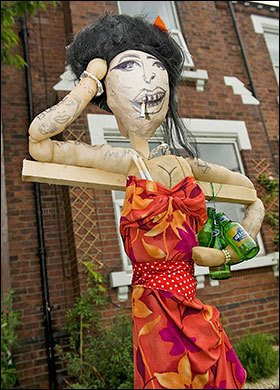
Madam Tussauds will reveal next month a wax model of Amy Winehouse. The wax figurine will have Amy’s tattoos and her beehive hairstyle.
When this news come after some guys in Yorkshire village Methley have created a scarecrow having Wino as a model I can only imagine that the wax figurine from Madam Tussauds must be very funny to see.
Below is the good looking and very frightening scarecrow
Source
Read more!
Tuesday, June 24, 2008
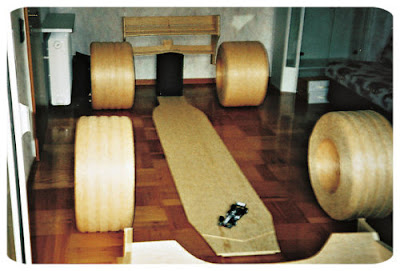
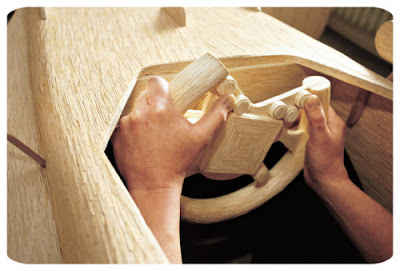
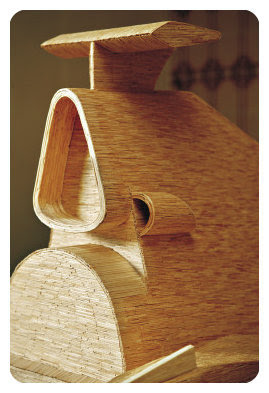
Man Builds Full Scale F1 Car From 956,000 Matchsticks
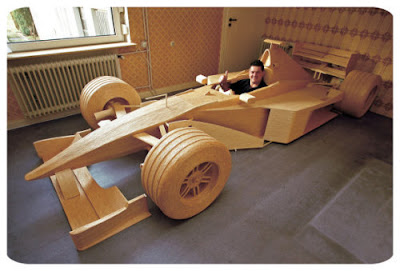
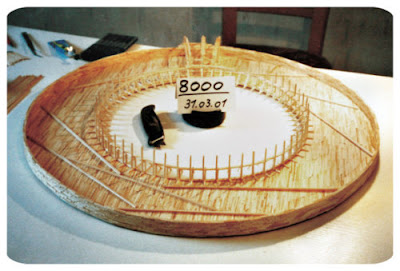
Man Builds Full Scale F1 Car From 956,000 Matchsticks Michael Arndt is a man of matchsticks. Over the course of six years, using 956,000 matchsticks, 1686 tubes of glue, and at least three different varieties of mustache, he built a full-scale replica of a McLaren 4/14 F1 car, at a cost of around 6000 Euros ($8,725). The giant model takes up Arndt's entire kitchen and probably his social life. It can be broken down into 45 parts for easy transport to various matchstick-builders conventions


 id="BLOGGER_PHOTO_ID_5215463403816598754" border="0" />


id="BLOGGER_PHOTO_ID_5215463403816598754" border="0" />Labels: amazing, Art, Design, Sports
Read more!Tuesday, May 06, 2008
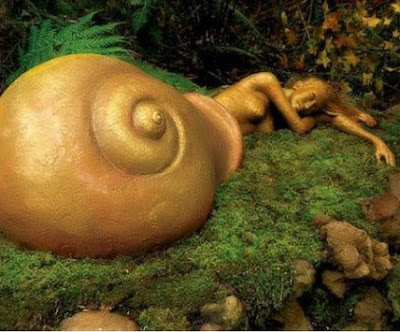
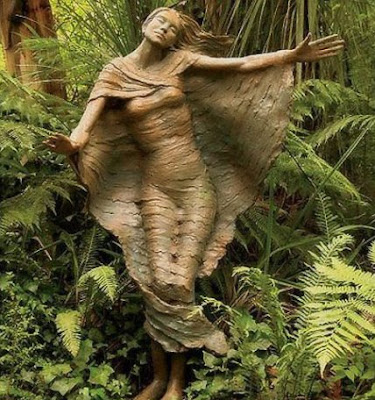
Sculptures of the Magical Forest




Friday, May 02, 2008
Original Google Logos by Google's Dennis Hwang



Meet "The Artist" of the Google Logos:
Computer artist doodles oodles of 'Google's
More than 150 million Web surfers around the globe celebrated Korean Independence Day Aug. 15, 2001. Well, at least for a few moments while they were visiting the popular Internet search engine Google. That day, the Korean national flag and several roses of Sharon, the Korean national flower, adorned the familiar "Google" logo on the homepage of the Web site.
,+a+23-year-old+Korean+computer+artist+in+the+United+States,.gif)
Just another day's work for Dennis Hwang (Hwang Jung-moak), a 23-year-old Korean computer artist in the United States, who has been drawing the face of Google for almost two years, creating a buzz of sorts with his simple yet witty designs.
With its seemingly magical ability to produce the most relevant search results, Google is already an established destination for the Internet savvy. Recently, Hwang's creative logos have been expressing the playful heart of Google behind the impressive technology.
For Piet Mondrian's birthday, Hwang transformed the "Google" logo to emulate the artist's signature style of utilizing colorful blocks. Claude Monet's birthday saw the logo turned into a dreamy watercolor, complete with floating lily pads.
Hwang recently spoke with The Korea Herald to give his take on the artistic side of the popular Internet search engine.
The Korea Herald: How long did you live in Korea as a child? What was it like?
Dennis Hwang: I was born in Knoxville, Tenn., but moved to Korea when I was about five years old. My hometown was Gwacheon where I had a very normal childhood. I went through public schools like everyone else, spending six years at Gwacheon Elementary School and two years at Munwon Middle School. Actually, much of my ideas and style stem from the time I spent during my childhood in Korea. Whatever challenges the logos bring, I can often rely on the little doodles that I used to do in school when I was young. Something that used to be frowned upon turned out to be my greatest asset.
Herald: When did you move back to the United States?
Hwang: I came back in 1992 when my father received a Fulbright Scholarship to research in the United States.
Herald: What was it like going to an American school all of a sudden?
Hwang: I was placed in a public middle school but was completely unprepared for it. I didn't speak a word of English. For the first six months, I couldn't communicate with the teachers or students. With the help of ESL programs though, I got better. My father returned to Korea, but my brother and I decided to continue our education in the States. My parents have made unimaginable sacrifices for us over the last 10 years, and I wouldn't be this successful without their support.
Herald: What was the first logo you designed for Google?
Hwang: Google had been using outside contractors to do the earlier logos, so the first project I got was modifying the Fourth of July logo in 2000. The two founders, Larry Page and Sergey Brin, wanted something more fun, so I redrew parts of the image. The next logo was for Bastille Day, which is the first logo I did from scratch.
Herald: Which letters are your favorite targets for manipulation?
Hwang: Understandably, the "O" and the "L" are the easiest to deal with. The "O" has become a Halloween pumpkin, a Nobel Prize medal, the Korean flag symbol and the planet earth. The "L" has been used as a flagpole, the Olympic flame cauldron or a snow ski. The first "G" is the most difficult to deal with, and I don't think the "E" has gotten much action because of its location.
Herald: How did you come to do the Korean Independence Day logo?
Hwang: Google makes a big effort to recognize holidays that aren't necessarily mainstream. The Korean Independence Day logo was seen globally by tens of millions of people. Numerous Korean-Americans wrote to thank us on Aug. 15 last year. Many expressed how proud it made them to see the Korean flag.
Herald: Do you have plans for other Korea-related logos in the future?
Hwang: I'll definitely to a special logo for Korea hosting the World Cup.
Herald: You're only 23 years old. What are your future plans?
Hwang: Who knows? It's very important to me that I can work both technically and artistically. Google is a perfect place to do that. It allows me to have a programming job while letting me express myself artistically, with the added bonus of having my work be seen by tens of millions of people in a single day.
Herald: What is your favorite letter among the ones found in the word "Google?"
Hwang: I've stared at the logo for so long and so often. I love them all equally.
(kimjin@koreaherald.co.kr)
By Kim Jin Staff reporter, source: Korea Herald source
Read more!
Monday, April 21, 2008
Awesome Light Graffiti! (New)

Here is a fresh batch made by Paulo Antunes. The technique is simple - set a slow shutter speed, wait till it gets dark, take a flash light or any other light source and you are good to go. When making figures you don’t need to repeat the pattern, one stoke to make the line is enough.
Read more!
Friday, April 18, 2008
Spinning Wheel Illusion

Spinning Wheel?
Is the wheel above spinning? Which way is it spinning? Does it seem to change directions at will? If it does seem to spin; the movement is all in your head.
It is actually just two pictures of the same wheel flipping rapidly back and forth.
Any continuous movement in this spinning wheel is illusory. It is simply 2 different pictures of the same wheel flipping back and forth. The first picture shows the wheel at the start position. The second picture is the same wheel, but rotated 10 degrees. When we see the 2 pictures flipping back and forth we think the wheel is spinning!
You could say that the wheel rotates 10 degrees, then jumps back to 0, then rotates 10 degrees again...endlessly. Because the wheel looks like it is starting to rotate, and we "expect" the wheel to rotate, we tend to follow an illusory movement around the circle in 10 degree jumps. The wheel will "rotate" in either direction with a little concentration.
Labels: Art
Read more!Friday, January 25, 2008
Stone me! Artist creates 20ft figure out of rock without using a hammer or chisel
An artist has spent three years scouring the globe for individual rocks which resemble body parts - to make a remarkable 2.5-tonne sculpture of the human form.
Duncan Elliott, 43, hauled stones ranging from the size of marbles up to 90kg from fields and mountains across Europe.
Each rock he used was precisely the right form - and proportionally the right size - for the body part it represents and has not been chipped or shaped.
Duncan Elliott, 43, hauled stones ranging from the size of marbles up to 90kg from fields and mountains across Europe.
Each rock he used was precisely the right form - and proportionally the right size - for the body part it represents and has not been chipped or shaped.

Quarry man: Fallen Angel, built from 300 individual pieces of stone which the sculptor hauled from across Europe
Enlarge the image
The biggest is a 90kg piece of Mendip limestone, for the belly. The smallest are pieces of limestone from Crete weighing less than a gramme each, for the fingernails.
Elliott attached the 300 rocks using a hidden steel cable skeleton to produce the 20ft-high Fallen Angel, which represents Satan being thrown out of heaven.
It has now been unveiled as the centrepiece of the Crown Plaza Hotel in Liverpool.
Elliott said: "The stones have flowing lines where they've been weathered by the elements over the years that give each one a uniquely natural shape.
"Putting it together is not easy. It's a labour of love, rolling boulders across mountain sides, but it puts you closer to the materials you are using.
"Some people think you're mad when you start looking at pebbles and telling them they'd make the perfect fingernail, but that's what's so exciting.
"You never know where you are going to find your next body part."
Elliott, from Bristol, studied at Bath Academy of Art, Leeds Polytechnic and then Goldsmiths College, London, and now has a studio at a farm on the Mendip Hills in Somerset where he pieced the sculpture together.
He has made around 60 sculptures over the last seven years and began after he was inspired by traditional Greek statues while living in Crete.
The majority of the rocks for Fallen Angel were found on the Mendips but others came from scouting missions across Europe, including return trips to Crete. All were lugged back by hand in a backpack or a sack trolley.
It took six-day weeks and 17-hour days to complete over three years, costing Elliott around £30,000 in labour and materials.
Enlarge the image
The biggest is a 90kg piece of Mendip limestone, for the belly. The smallest are pieces of limestone from Crete weighing less than a gramme each, for the fingernails.
Elliott attached the 300 rocks using a hidden steel cable skeleton to produce the 20ft-high Fallen Angel, which represents Satan being thrown out of heaven.
It has now been unveiled as the centrepiece of the Crown Plaza Hotel in Liverpool.
Elliott said: "The stones have flowing lines where they've been weathered by the elements over the years that give each one a uniquely natural shape.
"Putting it together is not easy. It's a labour of love, rolling boulders across mountain sides, but it puts you closer to the materials you are using.
"Some people think you're mad when you start looking at pebbles and telling them they'd make the perfect fingernail, but that's what's so exciting.
"You never know where you are going to find your next body part."
Elliott, from Bristol, studied at Bath Academy of Art, Leeds Polytechnic and then Goldsmiths College, London, and now has a studio at a farm on the Mendip Hills in Somerset where he pieced the sculpture together.
He has made around 60 sculptures over the last seven years and began after he was inspired by traditional Greek statues while living in Crete.
The majority of the rocks for Fallen Angel were found on the Mendips but others came from scouting missions across Europe, including return trips to Crete. All were lugged back by hand in a backpack or a sack trolley.
It took six-day weeks and 17-hour days to complete over three years, costing Elliott around £30,000 in labour and materials.

Piecing it together: Duncan Elliott at work in his studio, where he now hopes to produce even larger sculptures using his strictly chisel-free technique
Fallen Angel is the largest piece he has created so far - his last was only 2ft tall - but now he hopes to take on even bigger challenges.
He added: "Classical sculpture has always imposed the sculptor's will on the stone, hammering and grinding it. My work uses the natural form of the stones, untouched.
"The relationship is less dominating, more responsive - a new movement in stone."
Examples of where the rocks came from:
Fallen Angel is the largest piece he has created so far - his last was only 2ft tall - but now he hopes to take on even bigger challenges.
He added: "Classical sculpture has always imposed the sculptor's will on the stone, hammering and grinding it. My work uses the natural form of the stones, untouched.
"The relationship is less dominating, more responsive - a new movement in stone."
Examples of where the rocks came from:
•Fingernails - beaches of Panormo, north coast of Crete
•Left thigh - a churchyard in Bristol
•Parts of the wings - hillside on the Wye Valley, Monmouthshire and cliff tops in Paxos, Ionian Greece
•Parts of the ribs - foot of cliffs on Barafundle Bay beach, Pembrokeshire
•Ankle fibula - by a roadside near Rodopos, north coast of Crete
•Part of thigh - fields near Ashbourne, Derbyshire
•Part of foot - Black Mountains near Mazamet, Southern France
•Parts of face - hillside outcrop near Milford Haven, Pembrokeshire and mountains of Halki, Aegean Greece
•Parts of lower leg - on open ground near Lydford Gorge, Devon
•Biceps - Cheddar Gorge, Somerset
•Left thigh - a churchyard in Bristol
•Parts of the wings - hillside on the Wye Valley, Monmouthshire and cliff tops in Paxos, Ionian Greece
•Parts of the ribs - foot of cliffs on Barafundle Bay beach, Pembrokeshire
•Ankle fibula - by a roadside near Rodopos, north coast of Crete
•Part of thigh - fields near Ashbourne, Derbyshire
•Part of foot - Black Mountains near Mazamet, Southern France
•Parts of face - hillside outcrop near Milford Haven, Pembrokeshire and mountains of Halki, Aegean Greece
•Parts of lower leg - on open ground near Lydford Gorge, Devon
•Biceps - Cheddar Gorge, Somerset
Read more!