
Saturday, December 06, 2008
FLUSHED WITH PRIDE
The art of the toilet in Japan
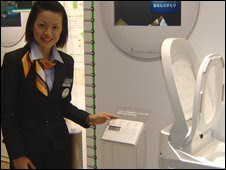 Smart young women at Panasonic show off the latest wares
Duncan Bartlett
(BBC)
No country takes toilets quite so seriously as Japan.
Machines with heated seats, built-in bidets and a dynamic range of flushing options are almost ubiquitous in homes and public buildings.
A poem recently published by a stressed-out salary man captured their comforting appeal with haiku-like brevity. "The only warmth in my life is the toilet seat," he mourned.
But lavatories here can do much more than keep you warm. One even sends a tiny electrical charge through the user's buttocks to check their body-fat ratio.
The master of the modern convenience is the Panasonic Corporation.
Booming market
At its Tokyo showroom, located in a skyscraper near the BBC's office, a group of smart young women, dressed in uniforms resembling flight attendants, showed me the company's latest wares.
The lids lifted up when I approached. If I stood in front of one, it took a guess at my gender and lifted up the seat as well.
There was a loo that glowed in the dark and another that had built-in loudspeakers.
With manicured fingernails, the demonstrator pushed the control panel beside the seat and gentle light classical music began to play.
Pleasant enough, I thought, although I preferred a pastoral sound effect that provided the impression one was seated upon a white plastic throne surrounded by songbirds in a springtime meadow.
 Japanese people do not see cleaning as a demeaning or shameful job
Kyoko Ishii, who heads up the public relations department for Panasonic, explained to me that most of the people who choose luxury loos are older women, so this is a booming market in rapidly ageing Japan.
Kyoko says that for this core customer group, the emphasis now is less on the gadgetry and more on convenience and cleanliness.
A new flush has been invented which does away with the need for a tank and saves dramatically on water.
The device costs about £1,950 ($3,000) including installation. But it is not easy to sell outside Japan as bathrooms in other countries are rarely fitted with the right mixture of sophisticated plumbing and electronics.
Clean culture
A visitor to Tokyo recently told me that he was surprised to find Japanese women rather than foreigners cleaning the toilets in his hotel.
 Advertisements for toilets are screened on public transport
It is of course often immigrants who take on such jobs in rich countries. But foreign-born workers are rare here as only about 1.5% of the population are made up of non-native Japanese.
However, the low immigration level is only part of the explanation. Japanese people do not see cleaning as a demeaning or shameful job.
School children are trained from a young age to sweep their classrooms and scour the playground for litter.
Lorry drivers wash their trucks at the end of every day. No restaurant ever serves a meal without first offering the customer a cleansing towel.
Recently, I visited a small technology company in Osaka. The president, Mr Sugimoto, is trying to inspire his staff to work harder as recession takes hold.
The Japanese - like the British - do not seem to mind too much when comedians sink into vulgarity and joke about scatological matters
He is noted for his drive and enthusiasm and that came across in a punchy presentation which he showed me on his laptop.
It included photographs of his staff on their knees scrubbing the urinals.
His point was that in preparation for a new project, the whole team had mucked in to clean up the workplace and this was clearly a source of pride to be included in the company's publicity.
Source of comfort
But toilets can raise a smile, too. Television comedies sometimes include scenes of pranksters luring people into loos whose walls then collapse, and the embarrassment this causes the victim is a source of great hilarity.
The toilet then appeared to give a welcoming robotic smile and its seat began to glow an inviting orange colour as it heated up, ready for action
The Japanese - like the British - do not seem to mind too much when comedians sink into vulgarity and joke about scatological matters.
But there is also a dark underground trade in DVDs filmed in ladies' toilets by hidden cameras, and only last week a man was arrested for placing "spycams" in the lavatories of a girls' school.
Most of the time, though, the Japanese are happy to think of a toilet as their comfort and their friend.
The other day, while catching a commuter train to work, I found myself transfixed by an advertisement which was being screened on a TV inside the carriage.
A young girl slowly walked towards a loo, which automatically raised its lid to greet her.
The toilet then appeared to give a welcoming robotic smile and its seat began to glow an inviting orange colour as it heated up, ready for action.
Fortunately, the advertisement ended there. But not before a broad and appreciative smile broke out across the face of the girl.
Read more!

Monday, November 24, 2008
Hotel Atlantis Lightshow Trial Run


Thursday, November 13, 2008
Pioneer Headlight Shoes
Unlike other shoes ,these pioneer Headlight shoes not only
light your path ,but their batteries are charged by your kinetic
energy as you move along.
light your path ,but their batteries are charged by your kinetic
energy as you move along.


Read more!
Saturday, June 28, 2008
Gold Statue of Santa

This statue of gold Santa Claus stands about 41 centimeters
high and weighs 20 kilograms, and demands a biting price
of 200 million yen ($1817,355). It features 23 diamond
beads that total 1.7 carats on its belt and
carries a sack, woven from extra-fine gold threads,
filled with 10 gold coins.
high and weighs 20 kilograms, and demands a biting price
of 200 million yen ($1817,355). It features 23 diamond
beads that total 1.7 carats on its belt and
carries a sack, woven from extra-fine gold threads,
filled with 10 gold coins.

Read more!
Wednesday, June 25, 2008
Rotating skyscraper set for Dubai
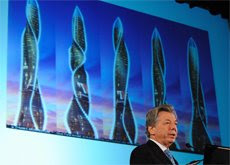
DYNAMIC TOWER: Italian architect David Fisher announces the world's first building in motion in New York. (Getty Images)
The "Dynamic Tower", a slender, shifting skyscraper of rotating luxury apartments, was presented in project-form Tuesday in New York by Italian architect David Fisher, before it goes up in Dubai.
The innovative, 420-metre building features 80 pre-fabricated apartments that spin 360 degrees, at voice command, around a central column by means of 79 power-generating wind turbines located between each floor.
"This building will have endless different shapes," Fisher told reporters.
As each floor rotates independently from the other, the Dynamic Tower will constantly change its profile, in a new architectural concept that is taking root around the world.
The Mirax group plans to build a similar, 70-story skyscraper in Moscow.
"We look forward to build a third one in New York and maybe in other cities," said Fisher.
"These buildings will open our vision all around, to a new life."
The apartments, ranging from 124 to 1,200 square metres will take between one and three hours to make a complete rotation, and at 30,000 dollars per square metre, will cost from $3.7 million to $36 million.
Fisher said the pre-fabricated components made in a plant in Altamura, southern Italy, will allow the skyscraper to go up in record time, one floor per week instead of the usual one-per-six-weeks for similar high rises, and slash building costs by 10 percent.
He said the skyscraper, which will be completely energy self sufficient and will cost an estimated $700 million dollars to build, should be operational in Dubai in 2010.
Labels: Design, Longest, Science, Technology, World Business
Read more!Tuesday, June 24, 2008
Man Builds Full Scale F1 Car From 956,000 Matchsticks
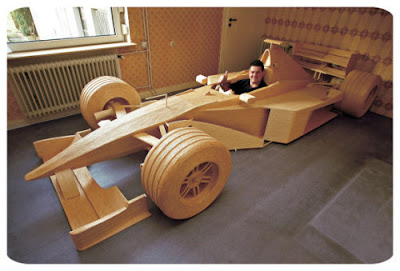
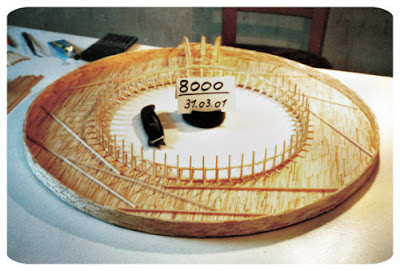
Man Builds Full Scale F1 Car From 956,000 Matchsticks Michael Arndt is a man of matchsticks. Over the course of six years, using 956,000 matchsticks, 1686 tubes of glue, and at least three different varieties of mustache, he built a full-scale replica of a McLaren 4/14 F1 car, at a cost of around 6000 Euros ($8,725). The giant model takes up Arndt's entire kitchen and probably his social life. It can be broken down into 45 parts for easy transport to various matchstick-builders conventions


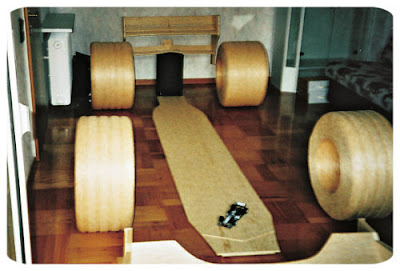 id="BLOGGER_PHOTO_ID_5215463403816598754" border="0" />


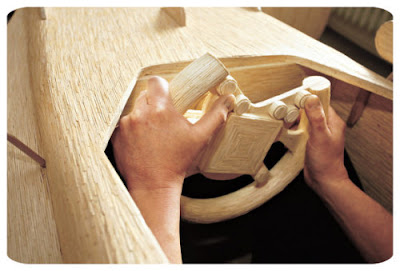
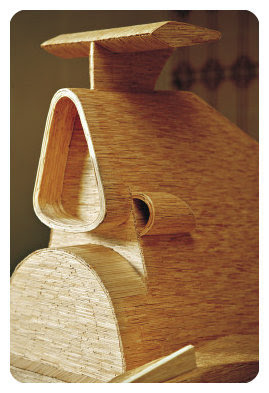
id="BLOGGER_PHOTO_ID_5215463403816598754" border="0" />Labels: amazing, Art, Design, Sports
Read more!Saturday, May 03, 2008
China First World's Longest Trans-sea Bridge Opens up In China

Hangzhou Bay Trans-sea Bridge was opened to traffics on a trial basis on May 1. China inaugurated the longest's bridge in the country as part of its effort to boost economic integration and development in the Yangtze River Delta.
Presented as the "world's longest sea bridge", the 36-kilometre (22-mile) structure connects Jiaxing city near Shanghai to the port city of Ningbo in the eastern province of Zhejiang.

The 11.8 billion yuan (US$1.7 billion) bridge cuts the length of the road trip from Shanghai to Ningbo by 120 kilometres. Link

HANGZHOU, June 8 (Xinhuanet) -- China started Sunday the construction of its first sea-crossing bridge, also said to be the longest in the world, at the Hangzhou Bay in east China.
With an estimated investment of 11.8 billion yuan (1.42 billionUS dollars), the 36-km-long Ningbo Hangzhou Bay Sea-crossing Bridge is much longer than the 25.23-km-long Chesapeke-Bay Bridge Tunnel in the United States and the 25-km-long Saudi Arabia Baharian Cause Way.
With a designed life span of 100 years, the bridge will have six lanes in two directions which allow for a driving speed of 100km per hour.
The Hangzhou Bay is a gulf in the East China Sea. Famous for the Qiantang River Tide, one of China's natural wonders, the bay is encircled by a group of economically booming cities including Shanghai, China's leading industrial and commercial hub, and Ningbo, one of China's leading port cities.
The Yangtze River delta, where the bay is located, accounts for two percent of China's total land space and 10 percent of its total population, but contributes to 22 percent of the national gross domestic product.
The S-shaped stayed-cable sea-crossing bridge, linking Cixi City on the southern bank of the bay and Jiaxing City on the northern bank, will be completed in 2008.
Upon completion, the bridge will shorten the distance between Shanghai and Ningbo by 120 km.
The bridge is a coastal routeway connecting the areas along theBohai Bay, the Yangtze River and Pearl River deltas. It is also the largest project of the planned 5,200-km-long national highway that runs through China from Tongjiang of northeast China's Heilongjiang Province to Sanya of south China's Hainan Province.
China's first self-designed and self-built bridge, the Qiantang River Bridge, about 200 km away from the new sea-crossing bridge, was completed in 1937. Up to now, China has constructed thousands of bridges on its rivers.
Construction of the new sea-crossing bridge is an indication of China's increasing economic power, and it is expected to boost economic development in the Yangtze River delta, said Jin Jianming,an official in charge of the bridge construction.
It shows that China now is capable of building world-class bridges, he noted.
Following the Hangzhou Bay bridge, a number of sea-crossing bridges at the Bohai Bay, Huangdao in Shandong Province and East China Sea will be constructed involving more than 100 billion yuan(12.09 billion US dollars), authoritative sources have disclosed.
In the early 20th century, Dr. Sun Yat-sen, forerunner of the democratic revolution of China, had initiated the construction of a Hangzhou Bay trans-sea bridge.
Preparations for constructing the bridge started 10 years ago, and more than 500 experts had spent eight years on designing the Hangzhou Bay bridge, which sets many records in China's history ofbridge construction.
Costing the biggest investment in building a single bridge in China, the bridge is the first State Council-approved large infrastructure project on China's mainland that invites private investment.
Seventeen private enterprises will invest 50.25 percent of the total funds needed to build the bridge. The remaining part of the investment will come from some state-owned enterprises.
Upon completion, daily traffic volume on the bridge is estimated to reach 45,000 vehicles during its first year of operation. The bridge is scheduled to open to traffic in 2009. source
Labels: amazing, Design, Technology, World Business
Read more!Friday, May 02, 2008
Original Google Logos by Google's Dennis Hwang



Meet "The Artist" of the Google Logos:
Computer artist doodles oodles of 'Google's
More than 150 million Web surfers around the globe celebrated Korean Independence Day Aug. 15, 2001. Well, at least for a few moments while they were visiting the popular Internet search engine Google. That day, the Korean national flag and several roses of Sharon, the Korean national flower, adorned the familiar "Google" logo on the homepage of the Web site.

Just another day's work for Dennis Hwang (Hwang Jung-moak), a 23-year-old Korean computer artist in the United States, who has been drawing the face of Google for almost two years, creating a buzz of sorts with his simple yet witty designs.
With its seemingly magical ability to produce the most relevant search results, Google is already an established destination for the Internet savvy. Recently, Hwang's creative logos have been expressing the playful heart of Google behind the impressive technology.
For Piet Mondrian's birthday, Hwang transformed the "Google" logo to emulate the artist's signature style of utilizing colorful blocks. Claude Monet's birthday saw the logo turned into a dreamy watercolor, complete with floating lily pads.
Hwang recently spoke with The Korea Herald to give his take on the artistic side of the popular Internet search engine.
The Korea Herald: How long did you live in Korea as a child? What was it like?
Dennis Hwang: I was born in Knoxville, Tenn., but moved to Korea when I was about five years old. My hometown was Gwacheon where I had a very normal childhood. I went through public schools like everyone else, spending six years at Gwacheon Elementary School and two years at Munwon Middle School. Actually, much of my ideas and style stem from the time I spent during my childhood in Korea. Whatever challenges the logos bring, I can often rely on the little doodles that I used to do in school when I was young. Something that used to be frowned upon turned out to be my greatest asset.
Herald: When did you move back to the United States?
Hwang: I came back in 1992 when my father received a Fulbright Scholarship to research in the United States.
Herald: What was it like going to an American school all of a sudden?
Hwang: I was placed in a public middle school but was completely unprepared for it. I didn't speak a word of English. For the first six months, I couldn't communicate with the teachers or students. With the help of ESL programs though, I got better. My father returned to Korea, but my brother and I decided to continue our education in the States. My parents have made unimaginable sacrifices for us over the last 10 years, and I wouldn't be this successful without their support.
Herald: What was the first logo you designed for Google?
Hwang: Google had been using outside contractors to do the earlier logos, so the first project I got was modifying the Fourth of July logo in 2000. The two founders, Larry Page and Sergey Brin, wanted something more fun, so I redrew parts of the image. The next logo was for Bastille Day, which is the first logo I did from scratch.
Herald: Which letters are your favorite targets for manipulation?
Hwang: Understandably, the "O" and the "L" are the easiest to deal with. The "O" has become a Halloween pumpkin, a Nobel Prize medal, the Korean flag symbol and the planet earth. The "L" has been used as a flagpole, the Olympic flame cauldron or a snow ski. The first "G" is the most difficult to deal with, and I don't think the "E" has gotten much action because of its location.
Herald: How did you come to do the Korean Independence Day logo?
Hwang: Google makes a big effort to recognize holidays that aren't necessarily mainstream. The Korean Independence Day logo was seen globally by tens of millions of people. Numerous Korean-Americans wrote to thank us on Aug. 15 last year. Many expressed how proud it made them to see the Korean flag.
Herald: Do you have plans for other Korea-related logos in the future?
Hwang: I'll definitely to a special logo for Korea hosting the World Cup.
Herald: You're only 23 years old. What are your future plans?
Hwang: Who knows? It's very important to me that I can work both technically and artistically. Google is a perfect place to do that. It allows me to have a programming job while letting me express myself artistically, with the added bonus of having my work be seen by tens of millions of people in a single day.
Herald: What is your favorite letter among the ones found in the word "Google?"
Hwang: I've stared at the logo for so long and so often. I love them all equally.
(kimjin@koreaherald.co.kr)
By Kim Jin Staff reporter, source: Korea Herald source
Read more!